
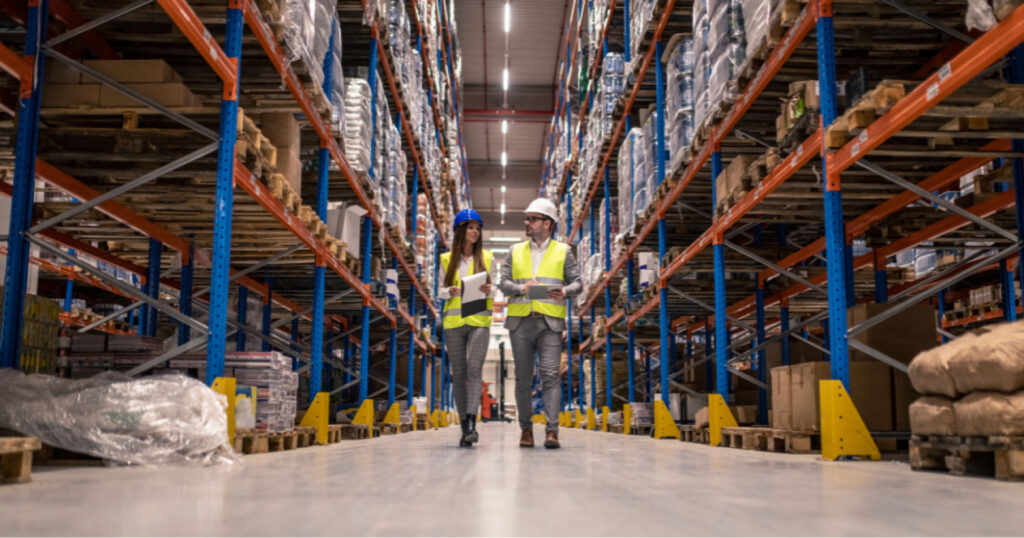
A distribution center doesn’t stop for cleaning. Forklifts keep moving, shifts overlap, and pallets get racked and re-racked around the clock, which means the vendor cleaning that facility isn’t just responsible for how it looks. They’re also responsible for how safely people move through it every day. Most facility managers only ask a cleaning vendor about price and schedule. Few ask about their OSHA protocol, and that’s the question that actually determines whether a contract protects the facility or exposes it.
Why OSHA Compliance Belongs In Every Cleaning RFP
A cleaning crew in an industrial or distribution environment works around forklift traffic, loading docks, racking, and pallet jacks: conditions with real injury risk if a vendor treats safety as an afterthought. When something goes wrong, the facility carries the liability alongside the vendor. Before a contract is signed, a facility manager should be able to confirm:
- A documented, written safety training program, not a verbal walkthrough on day one
- OSHA 10 and OSHA 30 certifications for crew leads and supervisors
- A current Experience Modification Rate (EMR) below 1.0
- Real-time inspection reporting, not a once-a-month checklist
- A written incident response protocol crews are actually trained on
If a vendor can’t produce documentation for any of these on request, that’s the answer to whether their “safety program” is a real system or a line on a sales sheet.
What an EMR Rating Actually Tells You
An Experience Modification Rate (EMR) is an insurance-industry score that reflects a company’s actual claims history against the industry average, which is set at 1.0. A rating below 1.0 means a company has fewer and less severe workplace injuries than its peers; above 1.0 means more. It’s not a marketing number. It’s calculated by insurers, which makes it one of the few safety metrics a vendor can’t spin.
JSBM‘s current EMR rating is .67. In practice, that means asking a prospective vendor for their EMR rating, and treating “we don’t track that” or “we’ll get back to you” as a red flag, not a technicality.
Two Areas Most Facility Managers Never Ask About
Two parts of a cleaning vendor’s operation almost never come up in a standard RFP, and both carry real OSHA exposure:
Chemical Handling
Under 29 CFR 1910.1200 (Hazard Communication), your vendor should maintain current Safety Data Sheets for every chemical used on-site, store and label them by compatibility class, and be able to produce training records showing crews know proper dilution and PPE requirements for each one. If a vendor can’t hand you an SDS binder on request, that’s not a paperwork gap. It’s a hazard communication violation waiting to be found by someone other than you.
Off-Hours Accountability
Most distribution center cleaning happens overnight or on off-shifts, which means most facility managers are trusting work they never see. A vendor with a real system logs off-hours cleaning with time-stamped completion records, not a verbal “it’s done,” and reports any spill, damage, or security concern discovered overnight before the next business day, not whenever it comes up.
The Questions To Ask Before You Sign
Most cleaning RFPs ask about scope, price, and start date. For an industrial or distribution facility, these matter just as much:
- What OSHA-aligned training does your crew receive before their first shift on our floor?
- What is your company’s current EMR rating, and can you provide documentation?
- Can you produce current SDS documentation for every chemical your crew uses on our site?
- How do you document and report near-misses or hazards found mid-shift?
- What does your corrective action process look like when a compliance gap is identified?
A vendor with a real safety program will have straightforward answers to all five. A vendor without one will start improvising.
The Questions To Ask Before You Sign
At JSBM, this isn’t a policy binder that exists for audits. It’s built into how crews are scheduled and managed day to day. Crews are trained under an OSHA-aligned safety program before they’re placed on a floor, with OSHA 10 and OSHA 30 certifications held across leads and supervisors. Field Inspection Supervisors conduct real-time inspections rather than relying on a monthly walkthrough, so issues get caught and documented as they happen, not weeks later. That combination of trained crews, a documented protocol, and a .67 EMR rating is what the JSBM Clean Standard is built around for industrial and distribution clients.
Everything above is a small piece of a much longer standard. We built a 33-point checklist across all 8 areas that matter for a distribution facility: floor and aisle sanitation, waste management, restroom and break area standards, chemical handling and SDS compliance, pest control coordination, staffing and accountability, off-hours visibility, and audit readiness. Use it to hold any vendor, including us, to a documented standard instead of a sales pitch.
Frequently Asked Questions
Is a cleaning vendor liable for OSHA violations at my facility?
A facility can share liability for an OSHA violation caused by a cleaning vendor’s practices, particularly if the facility knew or should have known about the gap. That’s why documentation, not just a verbal assurance, matters before signing a contract.
What is the OSHA standard for warehouse floor sanitation?
Warehouse floor and walkway sanitation falls under 29 CFR 1910.22 (Walking-Working Surfaces), which requires aisles, dock areas, and walkways to be kept clear of debris, spills, and obstructions, with a documented cleaning schedule.
How often should a distribution center’s restrooms and break areas be cleaned?
Restrooms and break areas in a high-occupancy distribution center should be cleaned on a fixed, documented daily schedule, with completion logged, not just verbally confirmed, and handwashing stations stocked at all times.
What certifications should a commercial cleaning vendor for an industrial facility hold?
Look for OSHA 10/30 certifications for supervisory staff, a documented EMR rating below 1.0, and, where relevant to the facility’s environmental policy, Green Seal certification for the products used.